A Fresnel lens to concentrate the beams towards the bowl
How to limit the losses of light by reflection towards the outside?
As we have just seen it before, it is possible to let enter a big quantity of visible and infrared beams to the oven. However some of them won't reach the bowl or the black plate at first time and will be reflect by the wall. Because of these reflections, they loose power before reaching the bowl or redirecting towards the outside. We thus thought of using a lens of Fresnel to concentrate the entrance light towards the bowl of cooking.
The Fresnel’s lens principle is quite simply because it bases on a convergent lens. Indeed, when it is crossed by beams of parallel light, it makes them converge in a point called focus of the lens F '. The distance between the focus and the lens’ center is called lens focal length f '. The advantage compared with a single lens, is that its thickness is clearly reduced by cutting it a set of concentric rings of prismatic section known by the name of “zones of Fresnel”. For each of these zones, the thickness is reduced, so the global surface of the lens is not smooth any more but consists of several surfaces of the same curvature, separated by discontinuities.
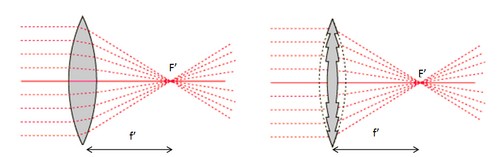
Experience and hypothesis : So, we thought that a Fresnel’s lens, would allow to concentrate beams towards the cooking bowl without absorbing too much energy. We would just have to place it on the first window of the oven. Of course, it make us ask many questions on the properties of the lens : certainly we wish to converge sunbeams entering towards the bowl, but they must not be concentrated in a point, at the risk of melting the bowl, or only burning the food. That is why, a focal length of 30 cms, seemed to us a good compromise whether it is for a pressure-cooker which can be located to only 10 cms of the window or a cake plate which will be it at the bottom of the oven or in 50 cms of the window.
Protocol: We exposed an oven until stabilization of its temperature. Then we added a Fresnel‘s lens concentrating beams on the black plate.
Results: The oven did not reached a higher temperature. On the contrary, it would have even lost two or three Celcius degrees.
Conclusion: the lens of Fresnel does not allow to increase the internal temperature of the oven, probably because it absorbs a not insignificant proportion of light.
Hypothesis and experience 17 bis: it is possible that if we concentrate the light on a black bowl containing some water, the watter’s temperature will grow faster.
Protocol: we let go up in temperature two ovens in the same conditions (normal incidence on the window + reflectors), then we introduced 1,00 L of water into everyone. On the window of the first one, we added a lens concentrating the light on the black bowl.
Results :
Case n°1: in 20 min, the water’s temperature increased from 21,3°C in 41,7 °C with a 106°C average temperature and an 21°C outside temperature. So we can found the power received by the water:

Case n°2: in 20 min, the temperature of the water increased from 21,3°C to 36,9 °C with an 112°C average temperature in the oven and a 21°C outside temperature.

Conclusion: By concentrating more beams on the bowl, the water absorbs more heat, what decreases the internal temperature of the oven at the same time, thus the losses towards the outside.